-INE Word Family Worksheet
Grades K-2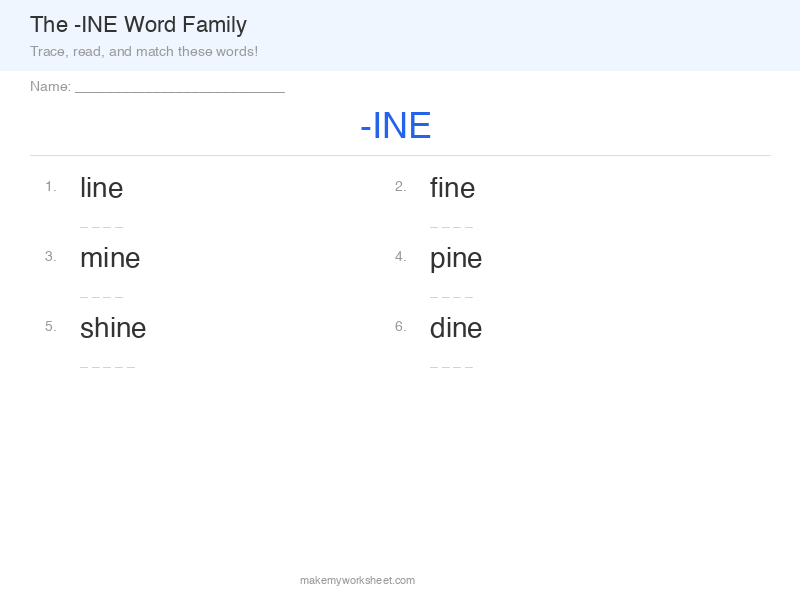 Printable · US Letter · Free
The -INE word family introduces young readers to the long I vowel pattern through a group of common, easy-to-read words. This free printable worksheet helps kindergarten through second grade students practice words that end in -INE: dine, fine, line, mine, nine, pine, vine, and wine. By recognizing this consistent pattern, children learn that the silent E at the end of each word makes the I say its name, a foundational phonics rule they will use throughout their reading lives.
What Does This Worksheet Cover?
This worksheet guides students through multiple activities designed to build mastery of the -INE phonics pattern. Students begin by reading and tracing each word in the -INE family to develop visual and motor familiarity. Next, they complete fill-in-the-blank sentences where context clues help them select the correct -INE word from a word bank. A rhyming exercise asks students to circle words that belong to the -INE family from a mixed list, sharpening their ability to distinguish this pattern from similar-looking words. Finally, a creative writing section encourages children to compose their own sentences using -INE words, moving from recognition to independent production.
Why the -INE Word Family Matters
The -INE family teaches one of the most important phonics concepts in English: the silent E rule, also called the magic E or bossy E pattern. When a word ends in a consonant followed by E, the preceding vowel typically makes its long sound. Understanding this rule through the -INE family gives children a tool they can apply to hundreds of other words across many word families. The -INE pattern also connects to the number word "nine," which means children encounter this family in both reading and math contexts. Strong word family knowledge has been shown to accelerate reading fluency because students can decode new words by analogy rather than sounding out each letter individually.
How to Use This Worksheet
- Emphasize the silent E: Before starting, explain that the E at the end of each word is silent but makes the I say its long sound. Compare "fin" (short I) with "fine" (long I) to demonstrate the difference.
- Read aloud together: Go through the word list together, having your child read each word aloud. Listen for correct pronunciation of the long I sound.
- Draw pictures: Ask your child to draw a quick picture next to words they can illustrate, like pine (a tree), vine (a climbing plant), or line (a straight mark).
- Create rhymes: Challenge your child to make up a silly rhyme or short poem using as many -INE words as possible. Rhyming strengthens phonemic awareness.
Tips for Parents and Educators
The -INE family is a great opportunity to teach the silent E rule explicitly. Write pairs of words on a whiteboard showing how adding E changes the vowel sound: pin/pine, fin/fine, din/dine. This comparison helps children internalize the rule rather than just memorize individual words. After your child completes this worksheet, extend the lesson with the -AKE word family worksheet, which demonstrates the same silent E rule with a different vowel. You can also revisit short-vowel families like the -IG family to contrast long and short vowel patterns and strengthen your child's overall phonics foundation.
Generate More Word Family Worksheets
Create unlimited custom word family worksheets tailored to your child's reading level.
Create Word Family Worksheets →