Counting 1 to 20 Worksheet
Grades K-1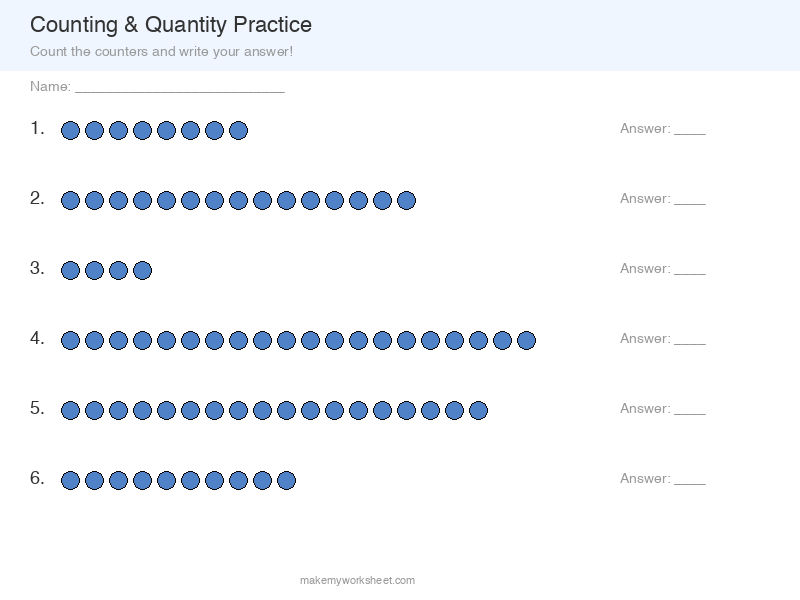 Printable · US Letter · Free
Learning to count from 1 to 20 is one of the earliest and most important math milestones for young children. This free printable worksheet helps kindergarten and first grade students practice number recognition, correct number formation, and sequential counting in a clear, structured format.
What Does This Worksheet Cover?
This counting worksheet focuses on three core skills: recognizing written numerals from 1 through 20, writing each number correctly, and understanding the counting sequence. Students may trace numbers, fill in missing numbers in a sequence, or match numerals to groups of objects. These exercises reinforce the connection between the symbol (the numeral) and the quantity it represents — a concept mathematicians call "cardinality."
Counting Strategies That Work
Children learn to count most effectively when they can connect numbers to real-world experience. Here are strategies that help:
- One-to-one correspondence: Have your child touch each object as they count it. This builds the understanding that each number word matches exactly one item.
- Count everything: Practice counting stairs as you walk up, grapes on a plate, or crayons in a box. The more contexts children count in, the stronger their number sense grows.
- Number lines: A simple number line on a desk or wall gives children a visual reference for number order and helps them self-correct when they skip a number.
- Start from different points: Once your child can count from 1, practice starting from 5, 10, or 14. This flexibility shows they truly understand the sequence rather than just reciting from memory.
Practice Activities to Pair With This Worksheet
Extend the learning beyond the printed page. Give your child a handful of small objects — buttons, dry beans, or toy animals — and ask them to count out specific quantities. Try asking "Can you give me 13 blocks?" or "How many spoons are on the table?" These hands-on counting activities solidify the skills practiced on the worksheet and make math feel natural rather than abstract.
Tips for Parents
Keep counting sessions short and positive. Five to ten minutes of focused practice is more productive than a longer session where attention drifts. If your child consistently struggles with numbers in the teens (a common challenge because English number words like "thirteen" and "fifteen" are irregular), slow down and give extra practice in that range. Once counting to 20 feels easy, your child is ready to explore addition within 10 and skip counting by 2s.
Generate More Math Worksheets
Create unlimited custom math worksheets tailored to your child's exact level.
Create Math Worksheets →