Subtraction Within 10 Worksheet
Grades K-1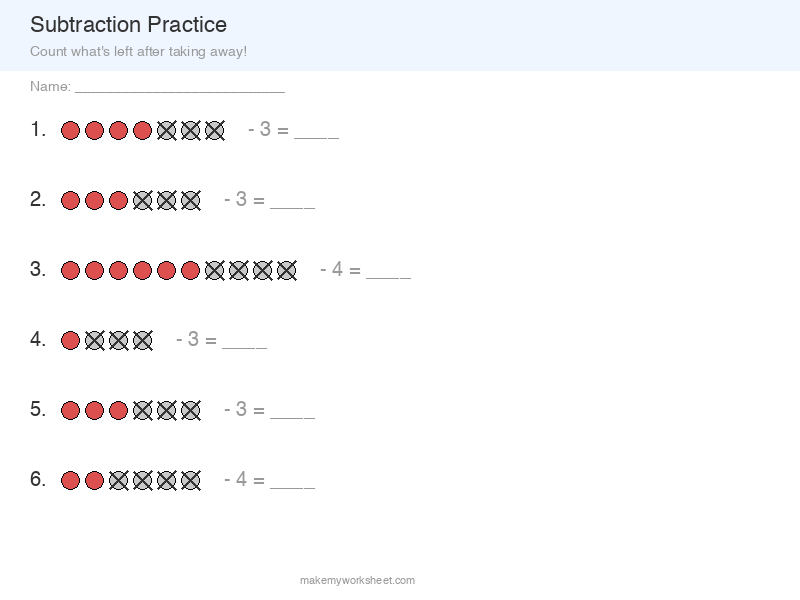 Printable · US Letter · Free
Subtraction is one of the four fundamental operations in arithmetic, and learning to subtract within 10 is a critical early math skill. This free printable worksheet gives kindergarten and first grade students structured practice with subtraction facts where the minuend (starting number) is 10 or less — problems like 8 - 3 = 5, 10 - 6 = 4, and 7 - 2 = 5.
What Does This Worksheet Cover?
This worksheet includes a range of subtraction problems presented in horizontal equation format. All problems use whole numbers between 0 and 10, and every difference is a non-negative number. Students practice the take-away model of subtraction — starting with a quantity and removing part of it to find what remains. This straightforward approach matches how young children naturally think about subtraction before they encounter more abstract models.
Key Subtraction Strategies
Children typically develop several strategies for solving subtraction problems. Understanding these strategies helps parents and educators guide learners effectively:
- Counting back: Starting from the larger number and counting backward. For 8 - 3, the child says "8... 7, 6, 5" and arrives at the answer. This is the most common beginner strategy.
- Counting up: For problems like 9 - 7, it can be easier to start at 7 and count up to 9 ("7... 8, 9 — that's 2"). This strategy works especially well when the two numbers are close together.
- Using a number line: Drawing hops backward on a number line provides a visual model that supports both counting back and counting up.
- Related addition facts: Once children know that 4 + 3 = 7, they can use that knowledge to solve 7 - 3 = 4. Building this addition-subtraction connection is one of the most powerful math skills at this level.
Common Errors to Watch For
Young learners often make predictable mistakes with subtraction. Watch for these patterns so you can address them early:
- Reversing the operation: Writing 3 - 8 instead of 8 - 3, or adding instead of subtracting. Reinforce the meaning of the minus sign.
- Off-by-one errors: When counting back, children sometimes include the starting number in their count. Practice with manipulatives helps correct this.
- Subtracting the smaller from the larger regardless of position: In a problem like 4 - 7, a child might write 3 because they always subtract the smaller number. At this level, all problems have non-negative answers, but being aware of this tendency helps later.
Tips for Parents
Use everyday situations to practice subtraction naturally. At snack time, say "You had 6 crackers and you ate 2 — how many are left?" During cleanup, ask "There were 9 blocks on the floor and you picked up 4 — how many are still there?" Connecting subtraction to real life builds lasting understanding. Once your child is comfortable with subtraction within 10, pair this worksheet with the addition within 10 worksheet to reinforce the relationship between the two operations.
Generate More Math Worksheets
Create unlimited custom math worksheets tailored to your child's exact level.
Create Math Worksheets →